Thursday, September 6, 2012

The National Music Museum -- Part 2

 The Music Museum at the University of South Dakota has two full floors of exhibits and we were delighted with what we found upstairs, beginning with this original foot pump organ.

 Upstairs, there is a wide variety of instruments, including a number of horns and brass instruments.

 There was also this harp guitar which was something we had never seen before. Apparently, this allowed (a skilled player!) to play harp music at the same time as they strummed the guitar. Apparently, it did not catch on.


 The harp guitar was not the only harp-related item. The harp zither is from 1920 and was made for a professional musician. I will bet it sounded great and wished we could have heard it.

 At the other end of the size spectrum is this square grand piano from 1891. This piano was given to a 14 year old girl who kept it in pristine condition her entire life and finally gifted it to the museum. The woodworking on this piano was amazing.

 Here is a very unique item - a double harp. Built in 1890, this is one of two known to exist with the other being in the Metropolitan Museum of Art in New York. I will bet this was quite a challenge to play.

 Here is an early electrified keyboard from about 1900. This forerunner of today's electronic organ used electric motors, relays, and more. The components are huge and really gives one an idea as to the great progress that has been made.

 
 Here is another remarkable grand piano from 1864. As with the other instruments, this one is in spectacular condition.

 Of course, the brass instruments are well represented as this display from the famous Conn Instrument firm. In fact, we realized that our son learned to play on a Conn trombone. Pretty cool.

 The museum offers a wide variety of instruments -- including this "Sargent Pepper" trumpet from the Sargent Pepper's Lonely Hearts Club movie featuring the Bee Gees and many others.

 Finally, we saw these saxophones and thought back to when our daughter played the Sax. However, we did not know then that the Sax was developed by Adolphe Sax back in 1857. These original saxophones are the ones that created this popular instrument in the future.

We learned quite a bit during our visit to the museum and really enjoyed seeing the wide variety of rare instruments. This is well worth a trip.

Wednesday, September 5, 2012

The National Music Museum at the University of South Dakota - AMAZING!

We drove down to Vermilion, SD to take a look at the campus of the University of South Dakota and the National Music Museum located on the campus. The University is a nice sized campus of over 10,000 students and is likely not the place you would expect to find a true, world class museum. 

 However, this museum hosts one of the finest collections of musical instruments and related items in the world. Offering some 15,000 exhibits, the range of instruments is absolutely incredible.

 Housed in an original 1910 Carnegie Library building, the museum offers a great site to explore musical instruments you will see no where else.

 This is the Guitar annex and Orinda was startled at all the guitars and related instruments on display. There were many, many unique and custom instruments located here and it was fun to learn about the history of each one. Many of these are relatively recent in construction -- especially compared to many items in the rest of the museum.

 For example, this Grand Piano from 1815 provided not only piano music, but also bassoon, harp, bells and a base drum. Built and played in Vienna, this gives an idea of the top of the line home entertainment instrument 200 years ago. Notice the spectacular, original condition of this piece -- the woodworking was amazing.

 How about this 1808 organ from Pennsylvania? Used until 1941, this is one of the best preserved American organs remaining. This is a BIG instrument!

 Many years ago, Rick had a brief encounter with violin lessons (which were dropped to the relief of Rick and his instructor!). Anyway, Rick has been intrigued with the instrument ever since and these example are truly unique. The instrument facing us is in original (unrestored ) condition -- which does not seem to be a big deal until you realize if was built in 1792!

 Now the paint on this harpsichord is a bit cracked, but otherwise, the instrument is in excellent condition. In fact, even the paint is in good condition considering it was built in 1530! Think about it -- folks alive in Christopher Columbus's day listened to this very instrument. Wow!

 This was one of Rick's favorite violins. Built in 1613, this is one of three un-altered example of a Cremonese (the location of the builder) violins in the world.

Here are other violins from same period (early 1600's) and in superb condition. Rick thought these looked alot like his rental violin in 4th grade, but he did not think the museum would let him try to squeak out a rendition of "Mary Had a Little Lamb" on one of these!

This museum is one of the most amazing museums we have been in. It really gives one pause to look at an instrument that is close to 500 years old. This is well worth the trip if you are in eastern South Dakota. 

Sunday, September 2, 2012

The Actual Sioux Falls in the City of Sioux Falls

One of our favorite stops while in Sioux Falls, South Dakota is at the real Sioux Falls which provides the name for the city. Located very close to downtown, the falls are now in a great park setting.

 The park provides an extensive walking area along the falls which allow you to see the falls from several different vantage points.

 The falls are on the Big Sioux River and pass through this extensive area of rose quartz rock. This sold rock is why the river falls though this area as it has withstood the erosion for centuries.

 Not surprisingly the falling water attracted interest from folks in the area who saw it as an opportunity to generate power for a grist mill and later, for electricity. In fact, just to the left of Orinda is an old turbine house that was used to power the flour mill built here.

This is the remains of the Queen Bee Flour Mill which was place in operation in 1881 and powered by the river. The mill was some 7 stories high and dominated the landscape here next to the river. 

This is the foundation for the large pipe that channeled water into the turbine house seen in the distance. The water dropped about 50 feet which was sufficient to provide about 800 hp for the operation of the mill. 

Here, Orinda provides a better view of the pipe support and gives an idea as to the size of the pipe and the distance that it ran to get to the flour mill. Unfortunately, the water volume was not sufficient to fully power the mill and it went bankrupt in 1883. The mill operated on and off for the next 40 years or so, but never fulfilled its hoped for production. 

This picture shows what the mill complex used to look like and gives an idea as to how the mill operated with the water feed pipe dropping into the turbine. The turbine was connected to a series of gears and shafts which then drove the mill. 

We are visiting in late summer and the water flow is at a low point, but it is still a beautiful place to visit as Rick and Orinda verify here.

The largest drop on the Falls is about 25', with a total drop of over 50'. At high water, the river expands well beyond the normal course seen here, and covers all the rock shown above. That is an impressive sight to see. 

 Orinda really enjoyed our visit to the Sioux Falls on this beautiful day. We are always surprised to find visitors to the area that have not heard of these great falls and would encourage anyone to pay them a visit.

Wednesday, August 29, 2012

The South Dakota Battleship Memorial in Sioux Falls

 Sioux Falls, South Dakota is the home of the Battleship South Dakota Memorial site. This is a great place to learn about the amazing history of this great WWII ship and its crew. Of special note is the large, blue shell seen above. This is the type of shell (weighing well over a ton) fired by the South Dakota'a main guns.

The South Dakota was 660' long with 9 huge 16" guns. This ship could travel at some 30 mph with her 130,000 hp engines. The South Dakota was heavily involved in many of the largest battles in WWII and was claimed to have been sunk by the Japanese at least twice. This lead to the battleship being called Battleship X so as not to give away the fact that the South Dakota had survived the battle intact. 

 There are many great artifacts in the memorial, including this remarkable steering station. Here, Rick imagines what it must have been like to steer 42,000 tons of battleship in formation while under attack from aircraft.

The South Dakota was also involved in one of the last battleship to battleship surface conflict in the Naval Battle of Guadalcanal where the South Dakota demolished several Japanese ships using guns like this one that fires a 16" shell that weighs over 2,600 pounds! Imagine that heading your way!

 Here is a shot of the breech of the massive gun that could shoot huge shells over 23 miles. Not only that, but these guns were so accurate that the South Dakota was able to hit enemy ships miles away with the first shots.

Of course, the gun barrels had to be cleaned as this sailor shows. This would be a very tight fit for most folks today and Rick was very happy he was not asked to clean this out!

 The memorial has a number of great exhibits, including this actual propeller from the South Dakota. This propeller is over 17' in diameter and weighs over 18 tons. It seems there is nothing small on a battleship.

 Inside the memorial building are many more artifacts and pictures covering all aspects of the ship, including this actual bell from the ship.

 Rick also learned that the Battleship South Dakota was not the first ship to carry the state's name. Indeed, this armored cruiser was named South Dakota was commissioned in 1908 and took part in WWI.

 There were many things to look at and learn. For example, the large Japanese battle flag seen above was surrendered to the South Dakota from the Japanese battleship Nagato at the conclusion of WWII. Interestingly, the Nagato was the only Japanese battleship that was still floating at the end of the war.

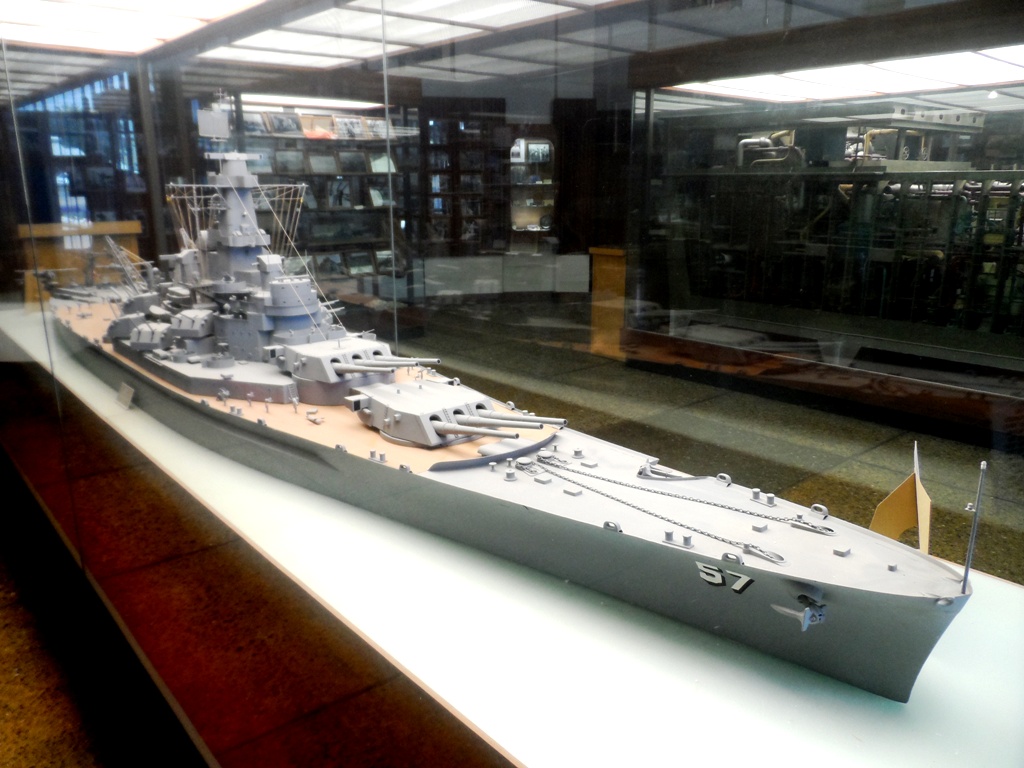
There is also this remarkable model of the South Dakota. This very large model is beautifully detailed and gives a great view of the entire ship. The Memorial is a great place to visit and should be a must stop if you are anywhere near Sioux Falls, SD.

Tuesday, August 28, 2012

Madison, SD -- A Visit Home

Before hitting the road fulltime in the motorhome, we lived for a number of years in Madison, SD, a relatively small city northwest of Sioux Falls. We really enjoyed our time in Madison and knowing the friendly folks who lived there. As you can see, Madison still has a real Main Street which is a pleasure to stroll along while shopping.

Of course, Madison was not always the tranquil town that you see now. Indeed, back in the 1874 era, the Town of Madison was established here, on the shore of Lake Madison.

But where is the town?? It turned out that the railroad decided to come through the area about 5 miles north of this location and the person holding that land, C.B. Kennedy, invited the residents of "old" Madison to move to his homestead and create a "new" Madison. This was done in 1880 and the town moved to its current location. 

The railroad is still a force in the city, but now, instead of hauling passengers, it predominately hauls corn and beans from the productive farmland in the area. 

When C. B. Kennedy offered land for the new City of Madison, he also provided land for a new University, which evolved into Dakota State University, located in the city area. 

Dakota State is a smaller public university (of about 2,500 students) that focuses on information technology as well as traditional liberal arts and sciences. Rick and Orinda were proud to be members of the Business faculty here and greatly enjoy returning to visit. 

 The campus is a beautiful enclave in Madison and offers everything that larger universities offer along with very student-focused attention. We were pleased to conclude our careers in higher education at this great school.

 One of the great leaders in South Dakota as well as at Dakota State was General William Beadle, whose statue Rick is standing next to. After a distinguished career in military service during the Civil War, Gen. Beadle was appointed as the Surveyor General of the Dakota Territory and later, President of the University. 

We also had to be sure to stop by our "home" here at MyDakotaAddress.com which serves as our mail forwarding and residency location. We have had great service over the years from Terri and her crown who operate the firm. It is fun to cal the couple thousand folks who "live" here neighbors!