Tuesday, September 20, 2011


 Just north of Salt Lake is the Golden Spike National Historic Site where the Central Pacific and Union Pacific Railroads completed the transcontinental railroad on May 10, 1869. This was the completion of perhaps the most important project in that century.

 This is a wonderful site and full of history. Just west of here is the site where the Central Pacific completed 10 miles of track in one day. Imagine, with no power tools, bulldozers, or the like, they were able to grade, place ties and rails for 10 miles in just one day.

 Here, at Promontory Summit, the final spike was driven to connect the rails and literally connect the country east to west. Many historians consider this to the be the equivalent of the Apollo moon project of more recent days -- indeed, exactly 100 years later, Neil Armstrong walked on the moon.

 Perhaps the most interesting part of the site is these exact recreations of the very locomotives that took place at the last spike ceremony. These are true, working locomotives and are fired with wood and coal, just like the actual ones over 140 years ago.

Yes, there really is a Golden Spike! While this one is a replica, the actual is in Stanford University -- so named for Leland Stanford, a founder of both the Central Pacific Railroad as well as Stanford University.

 Engine 119 represented the Union Pacific and uses coal. This 4-4-0 locomotive carried UP executives to the signing ceremony. These engines are actually used to recreate the meeting a couple of times a day and represent a rare chance to see live steam in action.

The Jupiter, from the Central Pacific, is a wood burner as evidenced by the large smoke stack which helped trap burning embers from the boiler fire. Rick loved these beautifully painted engines which are actually under fire. It is fun to hear them simmer and hiss getting ready for the next run.

 Imagine how exciting this must have been to slowly pull the Jupiter forward, peering through the wood smoke, to meet an engine from the east. The Jupiter, as with all CP engines to this time, had to be sent by ship around Cape Horn at the bottom of South America to reach California.

 While the current railroad now longer comes through Promontory, there are still many reminders of the past, including this actual piece of track from 1869. Rick is impressed!

While the locomotives were perhaps the stars of the site, there are many remarkable sites in the park area. Some of the most amazing are the grades that were created to carry the roadbed. This is the site of the Big Fill by the Central Pacific (the flat horizon in the center of the picture) which filled over 500' of ravine with up to 70' deep of fill. This was all done by 500 men using horses and was completed in 2 months.


This is the "Last Cut" made through solid rock and is about 15' deep. The rocks removed from this were removed from the cut (by hand) and then stacked in large piles next to the cut as can be seen above. The rocks were stacked largest rocks on the bottom of the pile with smaller ones on top to prevent them from dropping back in the dig. Seems that it worked pretty well -- they are still there today!


The original route was shown in the blue above and went to the north of the Great Salt Lake. This route faced many grades and curves due to the mountains, so many years later, another great project was undertaken to actually build the tracks over the lake itself on the Lucin Trestle, a 12 mile long wooden trestle. This amazing structure was completed in 1905 and since has been replaced by a causeway.

Monday, September 19, 2011

Hill Aerospace Museum on Hill AFB

 We arrived in Salt Lake City driving from West Yellowstone, Mt and spent a few days at the Pony Express RV Park (very nice spot) and had a bit of work done on the coach. Rick checked out the attractions in the area and lo and behold, there was an aircraft museum close by! Naturally, he wanted to visit the Hill Aerospace Museum located on Hill Air Force Base in Salt Lake. This turned out to be a great idea as this free museum was outstanding (even though Orinda choose to visit the local mall instead). There are aircraft everywhere, starting with this Wright aircraft of about 1910. This was a great exhibit and even displayed a reproduction of the engine used in the original 1903 Wright flyer (which was built by an Wright brothers bicycle shop employee!).


This P47 fighter was painted in the style of Glenn Eagleston, a famous WWII flying ace who came from Utah. Rick was drawn to this one immediately as he built a radio control model of this craft complete with the flying skull emblem.

 The aircraft were in outstanding shape and restored for exhibit by the museum volunteers. As you can see from this picture of this B17G (a BIG plane), there were planes everywhere. There is also a PT 13 training from the ceiling.

 Rick was in his glory here and greatly enjoyed learning about the planes. This B-24 shared a spot near the B-17 and allowed one to imagine how these huge bombers must have looked in the air almost 70 years ago.

 Of course, not everything was from the distant past. This B1 bomber is a current model and is an amazing craft capable of delivering 75,000lbs of armaments at well over the speed of sound. That is like two of our motorhomes at once! Yikes.

 Here is a rare B-29 from WWII fame. Interestingly, Hill AFB was used to repair battle damaged aircraft during WWII and saw hundreds of planes from all over. Today, the base is used for logistical support, AWACS operations and much more.

 It is always interesting to see how these planes are put together. This is in the nose gear compartment of a B-47 from the early 1950's. I was amazed at the number of wires running through the area as well as the boxes (one of which is in the upper right) holding relays, and servos. There are literally hundreds of moving components and miles of wiring. No wonder maintenance was such a critical issue -- and remains even with today's more reliable components.

Speaking of large planes, take a look at this C-124 Globemaster with it's 175' wingspan. Used from 1950's until the  mid '70's, this was a mainstream transport that moved gear world wide. 


 I was impressed with the excellent condition most of the aircraft were in -- not an easy thing to accomplish on 50 year old planes. Well, this is how it is done. A team of volunteers was working on this plane having already masked it and they were starting to paint it. It is nice to see this so folks in future years will be able to enjoy the planes as well.

Perhaps the best bomber of all time, this B52 has seen and done it all. Developed in the 50's, it still serves with distinction today. Commonly called BUFF -- Big Ugly Fat Fellow (although there are other variants for the last F), this is one of the great aircraft designs.

This is a great museum for anyone who is interested in aircraft. Well worth the time and trip.

Sunday, September 18, 2011

West Yellowstone Historic Center and Museum

 The West Yellowstone Historic Center and Museum is a great stop to learn about the early days of Yellowstone as well as the town of West Yellowstone. Located close to our RV park, we were surprised at the many exhibits and the low, $5 cost of admission. Here, Orinda considers an early 1900s baggage cart that was actually used here by travelers getting ready to enter the park.


One very interesting exhibit focuses on the early aviation routes into West Yellowstone and the park. Since we are at about 6,000' in elevation, the summers are pretty short and the winter is pretty long. As a result, many of the aircraft first coming into the area had to use skis such as these Orinda is taking a look at.

 These skis had an interesting story. These were actually used as shown int he picture of the monoplane above. After this time, the skis were stored in an airport employee's attic until recently when they were found and donated to the museum. These skis have some great stories to tell.

 While aircraft were the coming thing in the late 1930's and beyond, the real transportation heroes of the early days were the railroads. Indeed, the museum is actually housed in the old Union Pacific depot for West Yellowstone. In the early days, hundreds of tourists arrived by train several times a day to stay in the town, and then tour the park over the next few days or weeks. This old photo shows that some of the early railroads were a bit tenuous in nature -- this trestle looks much like some of Rick's old Erector construction set projects.

 Once you arrived at the park in, say 1905, there was the question of how you traveled from west Yellowstone to, say Old Faithful. Today, we think nothing of taking our car on the 30 mile trip, but imagine climbing up into this original stage to travel on the rutted dirt roads of the day for a long, bumpy ride into the park.

 Are you on a budget? If so, the stage fare might be a bit steep, so perhaps you would prefer this more basic wagon for the trip. Remember, according to pictures of travelers of the day that we saw, you would be sure to ride the wagon, on the dusty road, in your coat and tie. So, you would likely take up the wagon driver's offer to rent a duster to keep your clothes at least semi clean.  Hmmmm .... Orinda and Rick thought that our Buick looked pretty good to us and we enjoyed wearing our jeans.

 WHOA! Look out Orinda! This huge grizzly looked pretty mean, but fortunately, in his current, stuffed condition, is not much of a threat now. Still, look at those claws. We have seen grizzlies on earlier trips into the park, but this fellow is the only bear we saw this time.

Rick is reflecting on the difference between this early railway freight cart and his 42' Tour motorhome. While this is certainly a bit simpler to maintain, Rick thinks he will stay with the motorcoach. The museum was a great visit and we enjoyed taking a look into the Yellowstone travel of an earlier time. We wondered if, in 100 years, folks will look back at our RV and wondering how we lived as we did thinking about the folks we saw in the pictures.

Saturday, September 17, 2011

The Old Faithful Geyser Basin and a Rare Beehive Eruption

 The Old Faithful Geyser basin is an amazing place. With the Firehole river running right next to it, you can see scalding water run right into the cold river. There are a number of geysers, hot springs and bubbling pools along a walk of about 1.5miles.

 The path crosses over the Firehole river and the contrast is remarkable between the cool river and the steaming geyser basin just a few feet away.

 This is a typical bubbling geyser that is sending boiling water up in small spurts. The noise that these make sounds like a rapidly boiling pot on the stove.

 This is the Beehive geyser, and it is pretty obvious how it gets its name. This geyser is said to be one of the most impressive in the area, but erupts infrequently, so we did not expect to see it in action. You could see steam and some water rise from the top, so we thought it would be neat to actually see it.


About 30 minutes later, we were walking back across the Firehole River toward Old Faithful, when all of a sudden, the Beehive let loose! This was a very impressive geyser and rose a couple hundred feet in the air. The geyser lasted several minutes and we were very fortunate to be able to see it. Indeed, we have been through this area several other times and this is the first time we have ever see it erupt.

 This gives some idea as the size of the geyser basin. The wooden walkway is very nice and keeps folks off the fragile geyser crusts where you could fall through into the scalding water below. With that thought in mind, we made sure to stay on the path.

 The Old Faithful lodge dates from 1903 and is magnificent. This huge, log structure is a great place to drop in for some coffee (be sure to try the special cookies as well!). I don't know of any other place in the world where you can stay in a first class inn and look out over active geysers -- as well as see buffalo wander in the front yard.

 Of course, we had to get back to the Old Faithful geyser again to see it close up. Here, the geyser is just starting and is shooting water up about 40' feet of so. The eruption continues to build for several minutes.

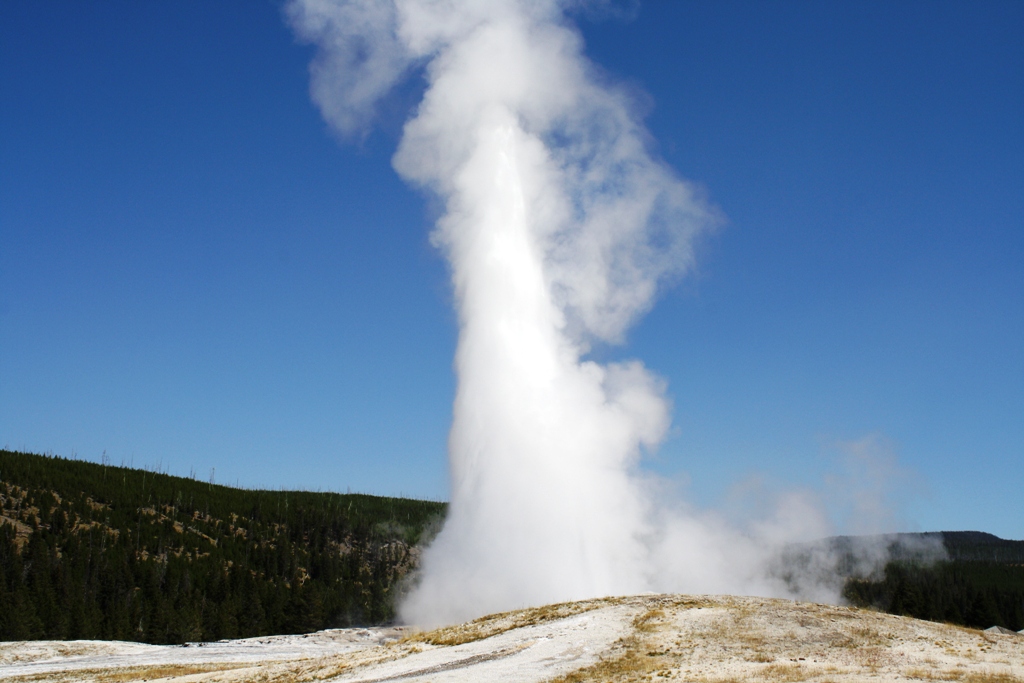
Finally, the geyser is erupting and dominates the area. While I suspect the Beehive geyser erupted for a longer time and perhaps was somewhat higher, the reliability of Old Faithful is what makes this one very special.

Friday, September 16, 2011

On to Old Faithful Geyser and Lodge

 Driving from West Yellowstone to Old Faithful Lodge, we drove along the Firehole River and River Drive. This is a beautiful, short drive along the river and these falls which cut directly through lava flows from the old Yellowstone volcano.

After the falls area, we came to a large meadow and started to get an idea why the river is called the Firehole. This large hot spring emptied right into the river and was probably about boiling temperature. The river is a classic high mountain river and is very cold -- imagine catching your trout and then cooking it right in this hot spring.This is a story that came from the early trappers that told of this when going back east -- of course, no one believed them. After seeing this in person, we certainly can believe it (although you can no longer put anything in one of the hot springs).

 The meadow was home to a herd of buffalo which we were happy to view from a distance after seeing the damage a buff did to another visitor's car. These are impressive animals and it is great to see them in the wild. You can see the calf to the extreme right of the herd.

This fellow was a bit closer than the rest of the herd and a number of people were getting pretty close to him.We did not think that was a very good idea at all since apparently the buffalo can run as fast as a horse for a short distance. Sure hate to be be in front of this guy when he came at me!


The head of the meadow was made up of a very active geyser area and it was very interesting to see the steam rising into the air next to the river.

We arrived at the Old Faithful Lodge about 45 minutes before the famous geyser was expected to erupt. As we waited, all of a sudden this buffalo decided to come by and watch the geyser too. He strode right up the walkway and as you can see, he was very close to people. The buffalo ambled through the area and walked out of the area.

 We decided that a nice cup of coffee was in order and sat down on the second story porch of the lodge so we could watch the eruption in comfort. Orinda also made sure she had one of the excellent cookies served in the cafe!

Old Faithful now erupts about every 90 minutes and is certainly worth the wait. Even from the porch, which was several hundred feet away, the geyser is impressive. The geyser shoots a couple hundred feet in the air and apparently uses about 8,000 gallons per eruption.

We were very fortunate to have a beautiful day to explore the geyser basin and the Old Faithful geyser was just like in the postcards. The geyser lasts for a fairly long time (a couple minutes) and is fun to watch. We decided that the next eruption would find us in the closer viewing area.

Wednesday, September 14, 2011

Buffalos and Norris Geyser Basin

 Yellowstone is the home to many buffalo and these big creatures roam all over. These weigh over 2,000 pounds and are very unpredictable. The park suggests that you stay clear of these fellows with good reason.

As we parked in the Norris Geyser Basin, we talked to the owner of this minivan who filled us in on their tale of woe involving a buffalo. It turns out that as he was stuck in a "buffalo jam" on one of the roads, a large buffalo walked up the middle of the road next to his car. All of a sudden, the buff turned and rammed the front of the car! Caved in the front fender, door, and outside mirror. Given that this had happened just an hour before we saw the damage, the owner was pretty impressed with the whole situation - as were we!

 The Norris Geyser basin is located in the middle of the park and is one of the largest geothermal areas, aside from the Old Faithful area. There are all kinds of activity here and we enjoyed a walk of about 1.5 miles checking it out.

This steaming vent was very large and made a loud hissing noise. the steam plumes were very high, and likely exceeded 50 to 75'

Orinda enjoyed looking at the many scalding springs in the area that was other wise devoid of any vegetation. If you look at this spring runoff, you can see the very green color caused by the algae that loves hot water.

Sure enough, a bit further on we found this sign that described the different color algae and their temperature zone.  The brown algae loves really hot water - 122 to 140 degrees! The green algae likes "cool" water by comparison and lives in 100 to 130 degree water. It was amazing to see water that would scald us actually providing a living environment for this algae.

 These steam vents blasted up from the earth and were very hot - above the boiling point. The earth crust surrounding these sorts of area can be very thin and could easily break through if folks tried to walk on it. As a result, we were very happy to stay on the wooden walkways.

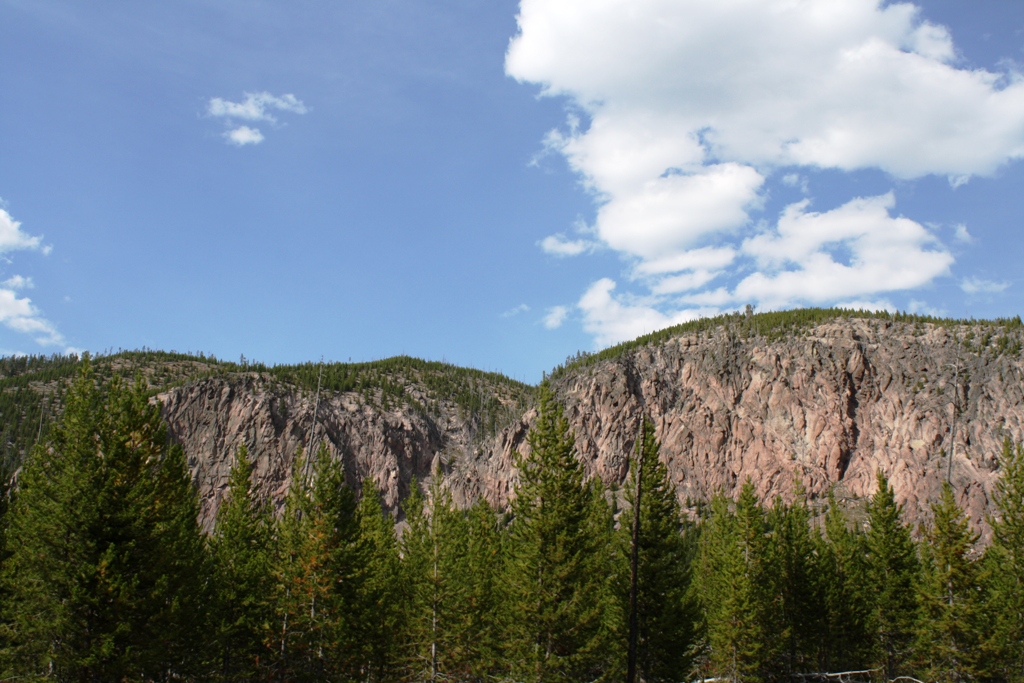
The amazing thermal features in the Yellowstone area is the result of an active volcano. In fact, the entire Yellowstone basin is actually a crater of an old volcano that erupted over 600,000 years ago. The amount of rock, lava and ash that was blown out must have been huge as evidenced by these cliffs which were said to be made up of "TUFF" rock, which was super hot ash blown up by the volcano then settling back and welding itself back into solid rock. This is A LOT of ash!